Saba Faisal Speaks Out on Viral Culture and Reveals Why Humsafar Changed Her Career
Saba Faisal opens up about viral clips, social media culture and professionalism while revealing why Humsafar became a major turning point in her acting career.
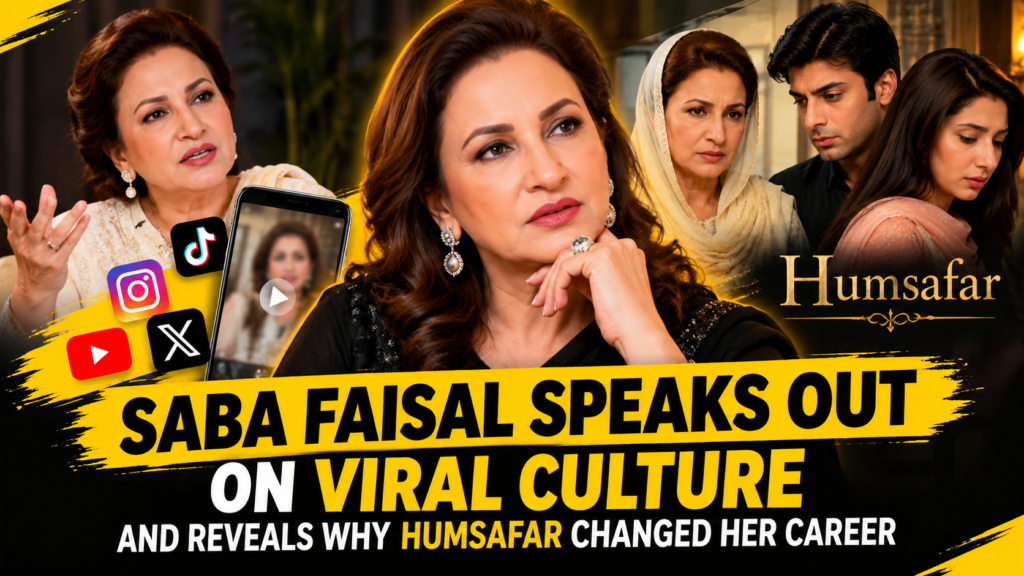
Saba Faisal has been part of Pakistani television for decades, but the entertainment industry she works in today looks very different from the one where she began her career.
Social media has changed how celebrities interact with audiences. Interviews can travel across platforms within minutes, while a few seconds taken from a longer conversation can suddenly become more popular than the interview itself.
For Saba Faisal, that growing obsession with viral moments has become a problem.
The veteran actress recently opened up about social media culture, misleading interview clips, professionalism in the entertainment industry and the drama that became a turning point in her acting career.
When a Short Clip Tells a Different Story
Celebrity interviews rarely remain in their original form anymore.
A conversation may last an hour, but many viewers will only see a short clip on Instagram, TikTok or another social platform. Sometimes those clips capture the original point perfectly. Other times, removing the surrounding conversation can completely change how a comment sounds.
Saba Faisal says she has experienced this herself.
Comments from interviews can be shortened, edited and presented in ways that create controversy around something that may have sounded completely different in context.
For an actor who has spent years building a reputation, seeing a few seconds become the entire story can be frustrating.
It has also made Saba more careful about what she says publicly.
Saba Faisal Questions the Obsession With Going Viral
Going viral has become its own kind of currency in entertainment.
A dramatic statement, unexpected reaction or controversial opinion can generate millions of views, and that naturally creates pressure to produce moments people will share.
Saba isn’t particularly impressed by that race for attention.
Her concern is less about social media itself and more about what happens when virality becomes more important than context.
There is a difference between an entertaining clip becoming popular naturally and editing someone’s words specifically to make them appear more controversial.
For celebrities, that difference can have real consequences.
A viral clip may disappear from people’s feeds within days, but the impression it creates can remain much longer.
She Wants More Respect Within the Entertainment Industry
Saba also spoke about criticism between people working in the same industry.
Actors will always be criticised. Audiences discuss performances, reviewers analyse dramas and social media gives everyone a place to share an opinion.
But criticism coming from fellow professionals can feel different.
Saba believes established artists deserve a certain level of professional respect, even when colleagues disagree with their performances or decisions.
Her comments touched on the wider question of how people in entertainment talk about one another publicly.
Disagreement is normal. Turning every disagreement into another public controversy doesn’t necessarily help anyone.
Professionalism Still Matters to Her
While social media may have changed the public side of being an actor, Saba’s approach to work sounds surprisingly traditional.
She places considerable importance on punctuality and respecting other people’s time.
Television sets involve far more than the actors appearing on screen. Directors, camera crews, makeup artists, production teams and dozens of other people may all be working according to the same schedule.
When one person consistently arrives late, everyone can be affected.
For Saba, professionalism isn’t only about delivering a good performance once the camera starts rolling. It also means being reliable enough for people to want to work with you again.
Talent may open doors, but discipline helps keep them open.
Why Family Dramas Continue to Dominate Pakistani Television
Saba Faisal has appeared in many family-based dramas, including stories involving complicated relationships between parents, children and in-laws.
These themes are sometimes criticised for appearing too frequently on Pakistani television.
Saba, however, looks at the situation from a practical perspective.
Production houses continue investing in family stories because they believe viewers connect with them.
Pakistani television has a large audience that watches dramas with the family, and stories involving marriage, parents, siblings and household relationships are immediately familiar to millions of viewers.
That doesn’t mean every family drama will work.
But it does help explain why producers continue returning to the genre.
Actors, meanwhile, aren’t always the people deciding what kind of projects get financed. Their decision is usually whether the character being offered gives them enough to work with.
Humsafar Became a Turning Point
Among everything Saba discussed, one part of her career still stands out clearly: Humsafar.
Before appearing in the drama, she felt she was frequently being offered glamorous characters where appearance was an important part of the role.
Humsafar gave her something different.
Saba played Maimoona, the mother of Fawad Khan’s character Ashar, in the drama that also starred Mahira Khan as Khirad.
The series went on to become one of the most widely remembered Pakistani dramas of its generation, but its importance to Saba wasn’t limited to its popularity.
The experience helped change the way she looked at acting.
Instead of focusing primarily on how a character appeared on screen, she began thinking more deeply about what a role could allow her to perform.
For an actress who would later become a familiar face in some of Pakistani television’s biggest dramas, that shift proved important.
A Career Bigger Than a Viral Moment
There is something ironic about Saba Faisal discussing viral culture.
She belongs to a generation of performers who built their careers one drama at a time, long before a short social media clip could reach millions of people overnight.
Today, both worlds exist together.
Actors still spend months working on television projects, but a 30-second interview clip can suddenly become the thing everyone is discussing.
Social media isn’t going anywhere, and viral moments will continue to be part of celebrity culture.
The more important question is how much context audiences are willing to lose in exchange for something quick and dramatic.
Saba Faisal’s comments are a useful reminder that the loudest clip isn’t always the complete story.
And after a career spanning years of television, perhaps that is exactly why she would rather be remembered for the work than for whatever happens to be trending for a day.
Do you think celebrity interviews are becoming too focused on viral moments and controversy?